Terror and Terrorism
READING
7 July 2005 London bombings
The 7 July 2005 London bombings were a series of coordinated bomb blasts that struck London's public transport system during the morning rush hour. At 8.50 a.m., three bombs exploded within fifty seconds of each other on three London Underground trains. The fourth bomb exploded on a bus nearly an hour later at 9.47a.m. in Tavistock Square. It is not clear when or how the bomber left the bombs at the bus. The police have appealed for witnesses. The bombings killed 52 commuters and the four suicide bombers, as well as causing a severe, day-long disruption of the city's transport and mobile telecommunications infrastructure. Metropolitan Police Commissioner Sir Ian Blair stated within a couple of hours of the explosions that he believed that they were "probably a major terrorist attack". He also indicated that police had found indications of explosives at one of the blast sites. The investigation thus concentrated on possible terrorist suspects.
Police examined about 2,500 items of CCTV (closed-circuit television) footage and forensic evidence from the scenes of the attacks. It is believed that each of the four bombs consisted of four and a half kilograms of high explosives, reportedly home-made acetone peroxide. The bombs were placed on the floors of the trains and bus, and two bombs were found unexploded in about 40 minutes after the first attacks. They were found on underground trains and destroyed using controlled explosions. The bombers were recorded on CCTV at Luton railway station at 8.30 a.m. on 7 July. Police investigators identified four men whom they alleged had in fact been suicide bombers. People with information regarding the bombings were asked to report it to the Home Office anti-terrorist hotline. On 1 September 2005, Al-Qaeda officially claimed responsibility for the attacks in a videotape aired on the Arab television network Al Jazeera.
The bombings came while the UK was hosting the first day of the 31st G8 (Great Eight) summit, a day after London was chosen to host the 2012 Summer Olympics. Fifty-six people, including the four perpetrators, were killed in the attacks and about 700 were injured. The incident was the deadliest single act of terrorism in the United Kingdom since Lockerbie (the 1988 bombing of Pan Am Flight 103 which killed 270 persons), and the deadliest bombing in London since the Second World War.
10x2=20
Task 1. Define the statements to be true (T) or false (F).
- On 7 July 2005 three bombs exploded within 50 seconds of each other on the London Underground.
- The fourth bomb exploded on a train at 9.47 a.m.
- The bombs were placed on the floor of the trains and bus by four suicide bombers.
- The police found two unexploded bombs on underground trains in about 40 minutes after the first attacks.
- It is believed that each of the four bombs was home-made and consisted of a half kilogram of high
explosives.
- The police couldn’t identify the four suspects recorded on CCTV.
- The total amount of killed is sixty persons.
- The 7 July 2005 was the first day of the 31st G8 summit.
- The bombing of Pan Am Flight 103 took fifty-six lives in 1988.
10. Nobody took the responsibility for the attacks on 7 July in London.
VOCABULARY
10x2=20
1. to destroy |
a) frightening |
2. aim |
b) blowing up |
3. intimidation |
c) to destruct |
4. explosion |
d) purpose |
5. to obtain |
e) to get |
6. regulation |
f) air piracy |
7. to fight |
g) weapon |
8. hijacking |
h) to combat |
9. firearm |
i) rule |
10. to demand |
j) to request |
5x2=10
1. a terrorist |
a) is the cruel killing of large numbers of civil people. |
2. a hostage |
b) is an illegal act of a person ( or a group ) who uses threat or force to take over control of an aircraft (or another vehicle), often for political aims. |
3. massacre |
c) is a person who uses threat or violence to achieve own aims. |
4. hijacking |
d) is an unpleasant and strong feeling caused by the presence or expectation of danger. |
5. fear |
e) is a person who is kept by enemy to force the other side to do what the enemy demands. |
5x2=10
a) frighten b) destruction c) order d) explosion e) freedom |
- The terrorist bombs caused widespread … .
- Four people were killed as a result of the … .
- Terrorists believe that they are “… fighters”.
- The main principle of terrorist activities is: “Kill one, … ten thousand”.
- Terrorist groups use the techniques of terror to destroy the … of the society.
10x1=10
Task 5. Put the following words into three logical groups.
a) hijacking f) extortion b) hostage g) victim c) enemy h) knife d) explosive i) kidnapping e) poison gas j) murder |
I Weapon |
II |
III |
5x2=10
Task 6. Complete the sentences.
1. The basic aims of terror organisations are … |
a) well-armed and prepared groups. |
2. The roots of terrorism are in the activities… |
b) diplomatic, economic, information, military, etc. |
3. The terrorism actions are usually committed by… |
c) have changed the nature of terrorism nowadays. |
4. Modern technology and new weapon … |
d) of racial and religious fanatics in the 1930s. |
5. Units for combating terrorists use every instrument of power – … |
e) to create atmosphere of fear and panic in society to achieve political and economic advantages. |
20
WRITING
Task 7. Use the information from the table to complete a report about the terrorist act (5-7 sentences).
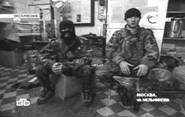
Moscow theater hostage crisis
|
|
Location |
Moscow, Dubrovka theatre |
Targets |
850 hostages |
Date |
October 23-26, 2002 |
Attack Type |
hostage crisis |
Perpetrators |
Movsar Barayev (leader) |
Motive |
forcing Russian military withdrawal from Chechnya and end to the Second Chechen War |
Killed |
129 hostages, 42 terrorists |
Weapon |
two kilograms of plastic explosives strapped to terrorists’ bodies |
Law enforcement |
FSB and SOBR unit stormed the theater and used top-secret fentanyl gas |