
Trafficking in women and children
READING
Human targets of inhumane trafficking
Trafficking in human beings is the commercial trade of human beings, who are subjected to involuntary acts such as begging, sexual exploitation (prostitution and forced marriage), or unfree labour. Trafficking involves a process of using physical force, fraud, deception, intimidation to obtain, recruit, and transport people.
Human trafficking differs from people smuggling. In the latter, people voluntarily request smuggler's service for fees and there is no deception involved in the agreement. On arrival at their destination, the smuggled person is either free, or is required to work under a job arranged by the smuggler until the debt is repaid. The trafficking victim is enslaved, or the terms of his debt bondage are fraudulent. The trafficker takes away the basic human rights of the victim. Trafficked persons usually come from poor regions, where opportunities are limited and they are often runaways, refugees, or other displaced persons. Other cases may involve parents who sell children to traffickers in order to pay off debts or gain income. Children are usually trafficked for labour exploitation and sexual exploitation.
Women form the majority of trafficking victims (about 80 per cent). Traffickers usually promise good jobs or opportunities for study, and then force the victims to be prostitutes. Many women are forced into the sex industry after answering false advertisements and others are simply kidnapped.
Ukraine is one of the world’s leading countries in terms of human trafficking in all of its forms. The matter is about the “supply” of women to foreign brothels, the export of pornographic goods and the export of bodily organs for transplants. Practically every week MIA (Ministry of Internal Affairs) subdivisions report the exposure and liquidation of brothels and pornographic studios. Advertisements of an intimate character in local expensive magazines and newspapers oriented towards foreigners are the proof of sex industry in Ukraine. Around a dozen large firms providing sex services are operating in Kyiv. They present themselves as massage parlors and modelling and escort agencies. Ukraine has become a major exporter of attractive girls to brothels abroad and for pornographic industry. The “goods” for sale are selected among teens that run away from home.
The export of human organs for transplants from Ukraine is a serious problem. Over the past years there were serious scandals related to illegal trading of human organs, but not a single case was examined in a court of law. In 2001 the “case of Lviv doctors” caught the attention of Ukrainian society. A group of doctors from a clinic in Lviv oblast was suspected of selling the kidneys of car accident victims. A kidney cost $10,000. The suspicions could not be proven. Last year human rights organisations attempted to learn the fate of 300 infants, who had disappeared from a Kharkiv maternity hospital. According to the parents of the stolen babies, they were born healthy, but the doctors took the infants away and announced that they were stillborn.

10x2=20
Task 1. Define the statements to be true (T) or false (F).
- The constituents in the process of human trafficking are using physical force, fraud, deception, intimidation to obtain, recruit, and transport people.
- Human trafficking is the same as people smuggling.
- The trafficked victim has no basic human rights and is enslaved.
- The majority of trafficked people are from poor regions, runaways, refugees, or other displaced persons.
- About eighty per cent of victims are women and children.
- It is known that a part of large firms in Kyiv present themselves as massage parlors, modelling and escort agencies but really they provide sex services.
- Ukraine is a major exporter of attractive girls to brothels abroad and for pornographic industry.
- In 2001 the “case of Lviv doctors” was examined in a court of law.
- Human trafficking is highly lucrative because people can be "sold" several times.
- In Ukraine the turnover of human trafficking is $8-12 billion monthly.
10x2=20
Task 2. Match the English and Ukrainian equivalents.
|
a) етнічні меншини |
|
b) примусова праця |
|
c) продати до борделю |
|
d) беззахисні жертви |
|
e) обманювати людину |
|
f) величезні прибутки |
|
g) сільська місцевість |
|
h) карати посередників |
|
i) бідність та військові конфлікти |
10. to sell to a brothel |
j) неправдиві обіцянки |
20x1=20
Task 3. Divide the words and word-combinations from the box into two logical groups.
a) traffickers f) deceit k) kidnapping p) officials b) bribery g) employment l) forgers q) slavery c) kidnappers h) poverty m) employers r) refugees d) forgery i) victims n) procurers s) debt bondage e) disparity j) identification o) slaves t) law enforcers |
Phenomenon / Activity People
10x2=20
Task 4. Match the synonyms.
1. temporary |
a) contract |
2. false |
b) aim |
3. impoverished |
c) borrowings |
4. profitable |
d) deceitful |
5. vulnerable |
e) request |
6. agreement |
f) lucrative |
7. debt |
g) short-term |
8. transit |
h) defenseless |
9. demand |
i) poor |
10. purpose |
j) transportation |
20
Task 5. Write a short composition (5-7 sentences), answering the questions and using the notes below.
Why is the term “human trafficking” defined as modern-day slavery?
Why is it called transnational organized crime?
What are the main causes of human trafficking?
What are victims of this crime?
What are the effective ways of combating this criminal activity?
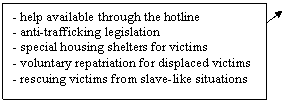 |
undocumented migrants |
| the use of force and fraud cheap labour / forced labour high profits can be made quickly, with little or no start-up capital people can be "sold" several times |