Great Britain
READING
Aspects of British monarchy
The United Kingdom is one of six constitutional monarchies in Europe. There is no such thing in Britain as absolute monarchy, so nowadays monarchs reign but don’t rule. At the same time, there is no constitution at all. There are acts, regulations, principles and procedures for the running of the country all the things that political scientists and legal experts study and which are known collectively as 'the constitution'.
The United Kingdom is a parliamentary democracy. The power of the monarch is limited by the Parliament which has existed since 1265, and it is the oldest parliament in the world. The main functions of Parliament are to pass laws and to debate the major issues of the day. The debating system is similar in both Houses (the House of Commons and the House of Lords). During the debate each member, except the person putting forward the motion, may speak once. The House of Commons (646 elected MPs) makes laws and has supremacy over the House of Lords which doesn’t have much power but can offer, change and delay laws. The House of Lords consists of about 1,100 peers, and they are not elected. They are aristocrats, people of the church, lawyers and former politicians. About 70 per cent of them are “hereditary peers” because their fathers were peers before them. The other 30 per cent are “life peers”, and their titles are not handed down to their children. They are officially appointed by the Queen for various services to the nation. Members of the House of Lords receive no salary for their parliamentary work.
Britain, unlike much of Western Europe, has 'single-party government'. All members of the government belong to the same political party. Traditionally, British politicians have regarded coalition government (with several parties involved) as a bad idea. The leader of the party which gets a majority of seats in a general election is named Prime Minister. He forms the group of ministers - the Cabinet. Ministers are collectively responsible for the policy conducted by the Cabinet. This means that a minister who does not agree with the decision of the Cabinet must resign. The second largest party becomes the official opposition -“Shadow Cabinet”.
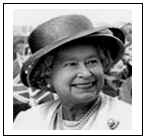 The British monarch is the head of the UK and also the head of fifteen other members of the Commonwealth, the Commander-in-chief of all armed forces and the Head of the Church of England. The monarch acts only on the advice of ministers and the Parliament. The present sovereign is Elizabeth II, who has reigned since 1952. The heir apparent is her eldest son, Prince Charles. Her reign of over half a century has seen ten different Prime Ministers of the UK. In matters of diplomacy, Elizabeth II is formal, and royal protocol is very strict. The Queen spends an average of three hours every day reading state papers. The Queen has never given press interviews. She speaks fluent French and uses the language for audiences and state visits. During her reign, she has made 256 official overseas visits to 129 different countries. Conservative in dress, she is well known for her decorative hats which allow her to be seen easily in a crowd. Her favourite clothes and flowers are bright red dresses and pink carnations. Her Majesty dislikes cigar smoke and tennis. Her main leisure interests include horse racing, photography, crosswords, watching comedy programmes and wildlife films. Elizabeth II is one of the wealthiest women. Recently Forbes magazine estimated her fortune at around £280 million. Since 1992 she has started to pay income tax. The Queen gives much money to charity. On her 21st birthday, Elizabeth promised: "My whole life, whether it is long or short, shall be devoted to the service of the people of the Commonwealth and Empire”. She is a really very popular monarch. If there was not monarchy 80 per cent of the British would vote for her as President.
Task 1. Define the statements to be true (T) or false (F).
- Besides the UK, there are six constitutional monarchies in Europe.
- British Parliament has existed since 1265, and it is the oldest parliament in the world.
- The House of Lords has more power than the House of Commons.
- MPs have no salary for their parliamentary work.
- Hereditary peers hand down their titles to their children.
- There is the multiparty government in Britain.
- If a minister does not agree with the decision of the Cabinet, he must resign.
- The British sovereign is the head of the UK and 15 other member-states of the Commonwealth.
- The Queen has visited more than 120 countries all over the world.
- Elizabeth II is one of the richest women, and she has never paid income tax.
10x2=20
VOCABULARY
Task 2. Group the following words and word-combinations into three logical groups.
1. Cabinet of Ministers 6. the House of Commons 11. Prime Minister 16. local administration |
Legislative power - …
Executive power - …
Judicial power - …
10x2=20
Task 3. Match the English and Ukrainian equivalents.
1. separate legal system |
a) обговорювати питання |
2. the United Kingdom |
b) загальне право |
3. common law |
c) Об’єднане Королівство |
4. political settlement |
d) політичне урегулювання |
5. to debate issues |
e) окрема юридична система |
6. High Court |
f) затверджувати розмір податку |
7. justice of peace |
g) Карний Суд |
8. the House of Commons |
h) Високий Суд |
9. Crown Court |
i) мировий суддя |
10. to approve taxation |
j) Палата Громад |
10x2=20
Task 4. Choose a word or word-combination to complete the sentences.
1. The largest part of Great Britain is …
a) Wales b) England c) Northern Ireland
2. The oldest institution of government is the …
a) judiciary b) executive c) monarchy
3. The British Parliament consists of the House of Lords and …
a) the Government b) the House of Commons c) the Prime Minister
4. Administratively Great Britain is divided into 55 … .
a) states b) counties c) oblasts
5. The head of Great Britain and the Commonwealth is … .
a) the Parliament b) the Queen c) the Prime Minister
6. Less serious cases are tried in …courts.
a) magistrates’ b) appeal c) juvenile
7. The administration of justice in Great Britain … both Parliament and the Government.
a) is controlled by b) is independent of c) depends on
8. Great Britain is the constitutional monarchy with the parliamentary … .
a) democracy b) republic c) kingdom
9. The … Party and the Conservative Party are the main political parties in the UK.
a) Liberal b) Common c) Labour
10. Prime Minister heads the Government and appoints … .
a) a jury b) ministers c) members of Parliament
10x2=20
WRITING
Task 5. Write 5-7 sentences to compare two states: Ukraine and the UK.
Examples of points for comparison:
- the system of government
- territory and population
- language(s)
- national character, etc.
20