Topic: Classification of Crimes |
Vocabulary notes:
cover v |
[’kʌvǝ] |
(тут) охоплювати |
commit v |
[kǝ’mit] |
вчиняти (злочин) |
lead to v |
[li:d] |
приводити до чогось |
disruption n |
[’dis’rʌpòǝn] |
зруйнування |
disadvantage n |
[,disǝd’va:ntiʤ] |
шкода |
felony n |
[‘fǝlɔni] |
кримінальний злочин (категорія тяжких злочинів) |
treasonn |
[‘tri:zǝn] |
зрада батьківщині |
misdemeanour n |
[’misdi’mi:nǝ] |
проступок, що підлягає судовому покаранню; злочин (категорія найменш небезпечних злочинів, які межують з адміністративними правопорушеннями) |
amount v |
[ǝ’maunt] |
доходити, становити, бути рівнозначним |
attempt n |
[ǝ’tempt] |
1.спроба, намагання; |
overthrow v |
[’ouvǝθrou] |
повалити, скидати |
destroy v |
[ distrɔi] |
руйнувати, знищувати |
to regard as |
[ ri’ga: did æz] |
розглядати як |
guilty adj |
[‘gilti] |
винний |
loss n |
[’lɔs] |
1.втрата; |
in addition to |
[in ǝ’diòǝn ] |
додатково до |
punishment n |
[’pʌniòmǝnt] |
покарання |
indictable crime |
[in’daitǝbl] |
злочин, що підлягає судовому переслідуванню |
offence n |
[ǝ’fens] |
злочин; порушення закону |
determine v |
[di’tǝ:min] |
вирішувати |
to be concerned with smth |
[kǝn’sǝ:nd] |
стосуватися чогось |
behaviour n |
[bi’heivjǝ] |
поведінка |
maintenance n |
[’meintǝnǝns] |
дотримання |
traffic n |
[’træfik] |
1. торгівля; 2. дорожній рух; 3. перевезення |
riot n |
[’raiǝt] |
1.порушення громадського спокою; |
sedition n |
[si’diʃǝn] |
1.заклик до заколоту; |
abuse n |
[ǝ’bju:s] |
1.зловживання; |
obstruction n |
[ǝb’strʌkʃn] |
перешкода, бойкотування |
destruction n |
[dis’trʌkʃn] |
руйнування, знищення |
extortion n |
[iks’tɔ:ʃǝn] |
вимагання, здирство; |
blackmail |
|
шантаж |
bribery n |
[’braibǝri] |
хабарництво |
perjury n |
[’pǝ:ʤǝri] |
лжесвідчення |
injury n |
[’inʤǝri] |
1.образа; 2.наклеп; |
nuisance n |
[’njusns] |
порушення громадського спокою |
include v |
[in’klu:d] |
включати в себе, охоплювати |
homicide n |
[,hɔmi’said] |
убивство |
assault n |
[ǝ’sɔ:lt] |
1.напад;2.згвалтування; |
rape n |
[reip] |
згвалтування |
abduction n |
[æb’dʌkòn] |
викрадення силою, обманом |
libel n |
[’laibǝl] |
наклеп |
stealing n |
[’sti:liŋ] |
1. крадіжка; 2. украдені речі (мн) |
robbery n |
[’rɔbǝri] |
грабіж, пограбування |
forgery n |
[’fɔ:ʤǝri] |
підробка, фальшування |
burglary n |
[’bǝ:glǝri] |
крадіжка зі зломом |
motor vehicle n |
[’moutǝ’vi:ikl] |
автомобіль, транспортний засіб |
рreviously adv |
[’pri:vjǝsli] |
раніше, заздалегідь |
convict v |
[kǝn’vikt] |
визнавати винним |
sentence n |
[’sentǝns] |
вирок; рішення (судове) |
imprisonment n |
[im’priznmǝnt] |
ув’язнення |
pickpocket n |
[’pik,pɔkit] |
кишеньковий злодій |
welfare |
[’welfƐǝ] |
добробут, достаток |
Classification of Crimes
Crime is a committed act, injurious to the public welfare and for which punishment is prescribed by law.
Crimes may be classified in a number of ways. The English common law classified crimes into treasons, felonies and misdemeanours. (Old classification).
Treasons cover those crimes which amount to an attempt to overthrow the monarch or to destroy the power of the state. They are regarded as the most serious of all crimes.
A felony is a serious crime but not as serious as treason. Commission of a felony involves the automatic loss of the guilty person’s land and goods in addition to punishment as handed out by the court. All other crimes are regarded as misdemeanours and are generally of a less serious nature.
In the modern context the most valuable classification of crimes is into indictable and non-indictable offences.
Indictable offences are those which are usually tried before a judge and jury with the jury responsible for determining the facts and the judge responsible for administering the law.
The indictable or more serious crimes may be classified further into six categories:
- The most serious of them cover offences against society or the state.They broadly cover those offences which were regarded as treason under the old common law classification. Specific examples are treason, riot and sedition.
- Those, which involve abuses and obstructions of public authority. These are those offences which would tend to prevent an organized society from functioning properly rather than lead to the destruction of the society itself. Examples are extortion, bribery and perjury.
- Those, which are regarded as offences, which will lead to injury of the public. These include offences against morality and offences which create nuisance to the public.
- Offences against a person. Examples of these would include homicide, assault, rape, abduction and libel.
- Offences against property. Examples of these would be stealing, robbery, forgery and burglary.
- The sixth group covers a variety of offences such as those connected with the driving of motor vehicles.
In non-indictable offences, which are usually known as summary offences, the trial will take place in a Magistrates’ Court without the jury.
They are generally concerned with the regulation of behaviour in a society and the maintenance of good order. Traffic offences of various kinds make up a very large proportion of the summary offences.
In accordance with the modern classification crimes are divided into arrestable and non-arrestable ones. An arrestable offence is any offence for which the sentence is fixed by law (murder) or for which a person, not previously convicted, may be sentenced to a term of imprisonment for five years or more (all offences of theft). Otherwise, an offence is a non-arrestable one. The classification of arrestable and non-arrestable offences is not therefore synonymous with that of felonies and misdemeanours.
Word families
criminal 1. злочинний 2.карний, кримінальний |
сriminal злочинець |
inсriminate обвинувачувати в скоєнні злочину |
сriminology кримінологія |
сrime злочин |
inсrimination обвинувачення в скоєнні злочину |
criminality злочинність |
сrimeful злочинний |
inсriminatory обвинувальний |
рunitive каральний |
рunish карати |
рunishable що заслуговує покарання |
|
рunishment |
|
remember
to prison ув’язнювати
suicide покінчити життя самогубством
to commit an offence, crime скоїти злочин
oneself компроментувати себе
a theft/larceny здійснювати крадіжку
murder ( тяжке вбивство)
killing pre-paid murder,contract murder (на замовлення)
вбивство assassination (підступне; з політичних мотивів)
manslaughter(неумисне)
felonious homicide (умисне)
larceny (особистих речей/власності)
pilfering (дрібних речей)
theft burglary (зі зломом)
stealing shoplifting (в магазині)
крадіжка motor-vehicle theft (автотранспорту)
pickpocketing (кишенькова)
REMEMBER
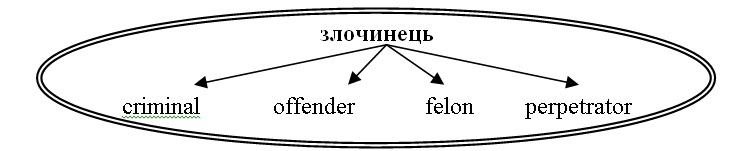
definitions of criminals
Thief is a person who steals things secretly, usually without violence. When violence is used, especially out of doors, a word robber is preferred:
Thieves stole ₤ 1,000 from the post office last night.
Robber is a person who steals something from a person or place, especially by violence or threat:
The robber stole ₤ 2,000 from a bank, by threatening people with a gun.
Pickpocket is a person who steals something out of your pocket in crowded places:
The pickpocket took the purse in a crowded train.
Burglar is a person who enters a building during the hours of darkness in order to steal. A person who enters a building in daylight to steal is a thief, or, if he breaks into a building by using force, is a house - breaker:
The burglars escaped through the window.
Shoplifter is a person who steals from the shops:
A security officer stopped the shoplifter who tried to leave the shop with unpaid goods.
Bigamist is a person who marries illegally, being married already.
Traitor is a person who betrays his or her country to another state.
Forger is a person who makes false money or signatures.
Smuggler is someone who gets goods into or out of a country illegally without paying duties.
Spy is a person who gets secret information from another country.
Kidnapper is someone who takes away people by force and demands money for their return.
Drug dealer is a person who buys and sells drugs illegally.
Terrorist is a person who uses violence for political, economical and religions reasons.
Arsonist is a person who sets fire to property illegally.
Accomplice is a person who helps a criminal in a criminal act.
Murderer is a person who kills someone.
Gangster is a member of a criminal group.
Crime |
Criminal |
Action |
murder |
murderer |
to murder |
shoplifting |
shoplifter |
to shoplift |
burglary |
burglar |
to burgle |
smuggling |
smuggler |
to smuggle |
arson |
arsonist |
to set fire to |
kidnapping |
kidnapper |
to kidnap |
killing |
killer |
to kill |
assassination |
assassin |
to assassinate |
theft |
thief |
to steal |
mugging |
mugger |
to mug |
robbery |
robber |
to rob |
pickpocketing |
pickpocket |
to pickpocket |
terrorism |
terrorist |
to terrorise |
blackmail |
blackmailer |
to blackmail |
drug-trafficking |
drug-trafficker |
to sell (to traffick) drugs |
forgery |
forger |
to forge |
assault |
assaulter |
to assault |
rape |
rapist/raper |
to rape |
swindle/fraud |
swindler\fraudster |
to swindle/to cheat |
perjury |
perjurer |
to violate an oath/to give false evidence |
Exercises
Ex. 1.Translate into Ukrainian :
crime, disruption, treason, felony, misdemeanour, to overthrow, sedition, forgery, guilty, punishment, court, summary offence, riot, robbery, rape, burglary, injury, bribery, extortion, abuse, nuisance, arrestable offence, a term of imprisonment.
Ex. 2. Match the English and Ukrainian equivalents:
common law |
зрада |
to lead to the disruption |
суд |
treason |
загальне право |
| riot | визнавати винним |
to convict |
призводити до руйнування |
to lead to the disadvantage |
шкодити |
offence |
згвалтування |
rape |
здійснити крадіжку |
to commit a larceny |
злочин |
court |
бунт, заколот |
Ex. 3. Explain in Ukrainian the meaning of the following words and expressions:
crime, to commit a crime, to lead to, common law, disruption, to be classified, treason, abduction, stealing, forgery, robbery, perjury, to prevent, abuse, homicide.
Ex. 4. Put the following words and word-combinations into three logical groups:
extortion, stealing, high treason, assault, bribery, abduction, riot, forgery, homicide, sedition, perjury, rape, trademark pirating, burglary, libel, abuse, smuggling, robbery, pickpocketing, kidnapping, counterfeiting, money laundering, drug trafficking, housebreaking.
сrimes against state |
crimes against person |
crimes against property |
Ex. 5. Match the following verbs with the nouns:
to commit |
the power of the state |
to kill |
suicide |
to destroy |
the destruction of the society |
to prevent |
the monarch |
to lead to |
a crime |
to overthrow |
the law |
to break |
a person |
Ex. 6. Translate the following word-combinations with the word “crime” into Ukrainian:
to prevent |
a crime
|
to charge with |
|
to commit |
|
to punish for |
|
to detect |
|
to deal with |
|
to disclose |
|
to investigate |
Ex.7. Put the right form of either rob or stealin the sentences below.
- Last night an armed gang……..the post office.
- They ………___₤2,000.
- My handbag ……….._at the theatre yesterday.
- Every year a large number of banks ……..__.
- Jane ………… of the opportunity to stand for president.
Ex. 8. Complete the following sentences with the words in the box. Translate them:
treasons, summary, offences, crimes, felony, theft, |
- Al Capone was a Chicago … .
- Indictable ... are those which are usually tried before a judge and jury.
- A ... was again a serious crime.
- All other ... were regarded as misdemeanours.
- The English common ... classified crimes into treasons, felonies and misdemeanours.
- ... offences are generally concerned with the regulation of behavior in a society and the maintenance of public order.
- The old classification of crimes involves …, felonies and misdemeanours.
- The two groups, … and non-indictable offences now overlap to some extent.
- …. steal for various reasons, some just for excitement, some out of necessity or greed, and others do it as a “profession”.
- Have you told the police about the … of your bicycle?
Ex. 9.Choose the correct answers to the following comprehension questions:
1. What are the most serious crimes?.
a) Traffic offences are the most serious crimes.
b) Originally treasons are regarded as the most serious of all crimes.
c) Offences against property are the most serious crimes.
2. What are indictable and non-indictable offences?
- Indictable offences are known as summary offences which are generally concerned with the regulation of behavior.
- Indictable offences are those which are usually tried before a judge and jury, with the jury determining the facts and the judge responsible for administering the law.
- In non-indictable offences, which are usually known as summary offences, the trial will take place in a Magistrates’ Court without the jury.
Ex. 10. Give English equivalents for the following words and word-combinations from the text:
злочин, суддя, дорожній рух, вбивство, згвалтування, крадіжка, грабіж, порушення громадського порядку, зрада, покарання, поведінка, лжесвідчення, хабарництво, винний.
Ex. 11. Translate the words from the box and complete the following sentences:
грабіжник, кишеньковий злодій, магазинний злодій, контрабандист, порушення громадського порядку, пограбувати, підробка |
- This picture is not really by Picasso. It is a_____________.
- In Britain, about 1,7 million ______ are caught every year.
- ________ stole $20, 000 from a bank, by threatening people with a gun.
- ________ took the purse in a crowded train.
- ________ is a person who brings goods into a country illegally without paying duties.
- A person is guilty of ________ only if he intends to use violence or is aware that his conduct may be violent.
- They _________ the museum last Saturday.
Ex. 12. Write down the answers to the following questions:
- What does the word "crime" cover?
- In what way may the crimes be classified?
- What is treason?
- Will you explain indictable and non-indictable crimes?
- What is the classification of indictable crimes?
- What do the non-indictable crimes cover?
Ex. 13. Give the proper definition for:
|
Murder - |
use of violence and intimidation, especially for political purposes. |
|
Mugging - |
act of stealing, especially secretly and without violence. |
|
Rape - |
act of setting something on fire intentionally and unlawfully, e.g. another person's property or one's own with the purpose of claiming under an insurance policy. |
|
Vandalism - |
act of person who steals things from shops while pretending to be a customer. |
|
Terrorism - |
unlawful killing of a human being on purpose. |
|
Theft - |
to attack somebody violently and rob (e. g. in a dark street, in a lift, in an empty corridor). |
|
Arson - |
act of committing crime by forcing sexual intercourse (on a woman or girl). |
|
Football |
act of destroying wilfully works of art or public and private property, spoiling the beauties of nature. |
|
Drug dealing - |
act of breaking something, act contrary to what one's conscience tells one to do, especially during football matches. |
|
Illegal parking - |
killing of many people at once, massacre; killing of people in road accidents. |
|
Manslaughter - |
unlawful placing a motor-vehicle. |
|
Shoplifting - |
distribution of drugs punishable by law. |
Ex. 14 . Translate into English:
1. Злочин – це протиправне суспільно-небезпечне діяння, за яке людина повинна нести покарання згідно закону.
2. Правоохоронні органи повинні запобігати скоєнню злочинів.
3. Англійське загальне право поділяє правопорушення на такі, які підлягають судовому переслідуванню та правопорушення, які не підлягають судовому переслідуванню.
4. Правопорушення, які не підлягають судовому переслідуванню, відомі під назвою “дисциплінарні”.
5. Дисциплінарні правопору-шення пов’язані з регулюванням поведінки в суспільстві та охороною правопорядку.
Ex .15. Translate into Ukrainian using the vocabulary below:
A new way to fight shoplifting
In Britain, about 1.7 million shoplifters are caught every year, but only about 150,000 less than 10 per cent, appear before the courts or receive a police caution. And only about 4,000, practically all of them repeat offenders, receive a prison sentence - like a 40-year-old career shoplifter, who in 25 years has come out of shops with unpaid-for merchandise about 18,000 times. Once he managed to steal nearly 200 bottles of whisky from a big supermarket in four hours, making various trolley trips.
One supermarket chain has cut shoplifting by half after taking civil action against thieves. They demand £150 plus legal costs from any thief who has been convicted or given a police caution. Those who refuse to pay face private prosecution and with it court costs, which could amount to thousands of pounds. Many American states are already operating such civil recovery procedures with great success.
career shoplifter |
[kə’riə] |
професійний магазинний злодій |
legal costs (pl) |
[’li:gəl kɔsts] |
судові витрати |
merchandise n |
[’mə:tʃəndaiz] |
товар |
civil recovery procedure |
[sivl ri’kʌvəri prə’si: ʤə] |
відшкодування збитків згідно цивільного права |
сaution n |
[’kɔ: ʃn] |
попередження |
prison sentence |
[’prizn ’sentəns] |
покарання у вигляді позбавлення волі |
trolley n |
[’trɔli] |
візок для покупок |
Ex. 16. Match the definition with the proper:
|
Terrorism
Theft
Arson
Shoplifting
Murder
Mugging
Rape
Vandalism
Football violence
Manslaughter
Illegal parking
Drug dealing |
Ex . 17. Retell the text using the following phrases:
The headline of the text is … . |
Violence in the Restaurant
On Saturday morning two intoxicated young men turned violent in a restaurant in Laboe and were thrown out by the owner. Shortly afterwards, they returned and started a brawl involving several guests. The brawl continued in the street, where one of the two hooligans drew a knife, stabbing one of the guests in the shoulder and in the thigh. The two hooligans, who were also carrying gas pistols, spent the day in the drying-out cell of the police station.
brawl |
[brɔ:l] |
галаслива сварка; вулична бійка |
intoxicated |
[in’tɔksikeitid] |
сп’янілий |
drаw a knife ( past від draw) |
[drɔ: naif] |
вийняти ніж |
drying-out cell |
|
витверезник |
Ex .18. Translate into Ukrainian using the vocabulary below:
Could you describe the case and its contents?
Policeman: Добрий день! Чим я можу Вам допомогти?
Foreigner: I can't speak Ukrainian. I can only speak English. Can you understand me?
Policeman: Yes, I can. I can speak some English. What can I do for you?
Foreigner: My case has been stolen.
Policeman: When and where did this happen?
Foreigner: In the station, just after I came on the train. It was about half past two. In the station, just after I came on the train. It was about half past two.
Policeman: Could you describe briefly what happened?
Foreigner: I got off the train and went over to a newspaper kiosk with the case in my hand. I put down the case while I was buying a map. When I had paid for it, I bent down to pick up my case, but it had gone.
Policeman: Did you see anyone who might have taken it?
Foreigner: There were a lot of people at the kiosk. But I didn't see anyone who looked like someone who would steal my case. No, I didn't see the thief.
Policeman: Come in and sit down. We’ll have to fill in a charge-sheet. So you didn’t see the thief.
Foreigner: No, I'm afraid not. I have no idea who could have stolen my case.
Policeman: May I see your passport?
Foreigner: Certainly. Here it is.
Policeman: Thank you. What is your marital status and your occupation – your job, you know?
Foreigner: I'm single. I'm a sales manager in a big English company.
Policeman: What is your home address?
Foreigner: 2 Acacia Drive, Beverley, London.
Policeman: Can we contact you here in England any time. Over the next few days?
Foreigner: I'll be staying in hotel “Dnipro” here in Kyiv over the next three weeks. Then I'll be going straight home. Luckily I still have my money and my credit cards.
Policeman: Could you describe the case and its contents?
Foreigner: It was a light brown leather suitcase - nothing very special. There were towels, underwear, toiletries, shirts, two pairs of shoes and three pairs of trousers in it.
Policeman: How much was the case worth - including the contents?
Foreigner: Oh, I think ... it must have been worth about 300 Euro.
Policeman: You have the right to be informed when the case has been closed. Even if you renounce this right, you will, of course, be informed if and when the thief is found.
Foreigner: O.K. Well then, you needn't inform me when the case has been closed.
Policeman: I’ll translate the charge-sheet for you again. Would you please sign it here? ... Thank you.
Foreigner: Could you give me a certificate for my insurance company?
Policeman: Yes, certainly. I’ll fill in a form called „Довідка”. You can give this form to your insurance company. I think that’s everything. I hope you’ll enjoy the rest of your stay. Good bye.
Foreigner: Good bye and thank you very much.
bend down |
[bend] [daun] |
згинатися |
pick up |
[pik] |
піднімати |
charge-sheet |
[tʃa:ʤ] [ʃi:t] |
формуляр |
content |
[‘kɔntent] |
вміст |
worth |
[wə:θ] |
цінність |
renounce |
[ri’nauns] |
відмовлятися |
certificate |
[sə’tifikit] |
підтвердження |
Grammar exercises
Grammar: Passive Voice |
Ex. 1. Make up 5 sentences from each table, define the grammar form of predicate:
We are always given much home-task in English |
The newspaper “Kyiv Post” |
am is are may be |
classified read asked radioed regarded |
in a number of ways. |
Crimes |
by many people in Ukraine and abroad. |
||
This information |
often at the lessons. |
||
I |
as offences which will lead to injury to the public. |
||
Extortion, bribery and perjury |
to the detective department. |
These two cars |
was were |
not answered made shared driven away spoken |
much about last week. |
Responsibility for improvement of the road network |
in English by our cadet Taras Bondarchuk. |
||
This road accident |
last year. |
||
The report “Classification of crimes” at the International conference |
by the criminal. |
||
The question of the judge |
between central and local government. |
The investigation of this case |
will be |
signed finished repaired caught packed |
next week. |
Those cars |
tomorrow. |
||
The report of our chief |
in a month. |
||
This criminal |
in half an hour. |
||
Your things |
by policemen in a few days. |
A person and vehicle check |
is being are being
|
translated built conducted committed constructed |
by young criminals in cities and towns now. |
A lot of crimes |
by a police officer. |
||
A new building |
by the first-year cadets now. |
||
This text |
on the territory of our Academy. |
||
Many new houses |
in Kyiv. |
The report about felonies in this district |
was being were being |
driven read discussed translated |
by the cadet Roman Petrusenko when I came into his room |
A new book on criminology |
out of the city from 3 till 5 a.m. |
||
Stolen cars |
in the Investigation p.m. Department from 5 till 7 p.m. yesterday. |
My watch |
has been have been |
taken robbed stolen built committed |
to prison for their crimes. |
This bank |
by a thief. |
||
Some pickpockets |
by the time of its opening. |
||
Some cars |
during night hours. |
||
The new underground station |
this year. |
My car |
had been |
translated signed stolen adopted robbed |
by the 1st of January, 2000. |
The treaty between British Police and Ukrainian Militia on cooperation in fighting against drug dealers |
by the coming of our professor. |
||
This scientific article |
by the time when I came. |
||
The Post Office |
by the end of the meeting. |
||
The resolution |
by the opening of it. |
Ex. 2. Put the following sentences into interrogative and negative forms.Translate them:
- The activity of Militia is regulated both by legislative and departmental documents.
- The tickets to Lviv were booked yesterday.
- Non-indictable offences are known as summary offences.
- Originally treasons are regarded as the most serious of all crimes.
- He was robbed of all his money yesterday.
- Felony is regarded as a very serious crime.
- The group of foreign policemen was shown the Museum of Ukrainian Art during their stay in Kyiv.
- The indictable or more serious crimes may be classified into six categories.
- The travellers have been attacked in the mountains and robbed of everything they had.
Ex. 3. Put the following sentences into the Passive Voice:
A boy broke the window in the house yesterday. |
- The Militiamen arrested this young boy for his crime yesterday.
- A motorist killed the pedestrian after an evening’s drinking.
- A customs officer is checking the passenger’s luggage.
- By the coming of the investigator the militia officer had found the pistol in the room.
- A murderer has killed a young girl.
- They were selling drugs when the police officer came up to them.
- They often ask questions at the lessons.
- Our guide has shown the Museum of Militia of Ukraine to the foreign policemen.
- He killed a young girl with a knife some days ago.
- A militiaman had arrested the criminal before the expert criminalist arrived.
- The first-year cadets were reading many books on law during the first three months of their studies.
- The builders have built a new church on the territory of the Central Hospital of the Ministry of Internal Affairs of Ukraine.
- They spoke much about the report “Classification of crimes” at the International conference on Law.
- They are discussing the report about the felonies in this district.
- A group of men killed some customers in a pub by leaving a bomb there.
- Police arrested two groups of rival football supporters who started a battle.
Ex. 4. Put the questions to the words printed in bold:
- Ukraine has been recognized by 152 states.
- People were impressed by American President’s knowledge of Ukrainian poetry, when he recited some lines by Taras Shevchenko.
- The National Anthem of Ukraine was created by Mikhailo Verbytskyi and Pavlo Chubynskyi in 19th century.
- The tools of investigator are referred to as the three “i’s”, namely, Information, Interrogation and Instrumentation.
- The train to Lviv has been announced.
Ex. 5. Retell the story, using the Passive Voice:
Police constable Drake is sipping his usual dram of whisky after his late shift and tells his wife about the day.
“Today we stopped Mr. Merry from Beer in Devon in the pedestrian precinct. We asked him to show us his papers. As he seemed to be drunk, we breathalyzed him and then told him to get out of his car. Then we left his car where it was and escorted him on foot to the police station. There we called a doctor who took a blood sample. Finally we put him in our detention cell to sober up.”
Two days later Mr Merry tells his wife: ”The day before yesterday I was stopped …”
breathalyze someone зробити комусь алкотест
blood sample аналіз крові
detention cell медвитверезник
dram (тут) чарка
sip пити маленькими ковтками
sober up протверезитися
Ex. 6. Translate into English.
- Розслідування кримінальної справи буде завершено до нового року.
- Злочинець був заарештований поліцейським перед тим, як прибув експерт-криміналіст.
- Це завдання було розв’язано курсантами.
- Наказ був вчора підписаний начальником.
- Цей англійський текст зараз перекладається курсантом Богданом Романенком.
- Повідомлення було одержано о 5 годині вечора.