Topic: Great Britain Grammar: Reported speech |
Vocabulary notes:
government n |
[’gʌvnmənt] |
уряд |
сommunity n |
[kə’mju:niti] |
суспільство |
settlement n |
[’setlment] |
урегулювання |
acceptable adj |
[ək’septəbl] |
прийнятний |
recognition n |
[rekəg’niʃən] |
визнання |
distinction n |
[‘dis’tinkʃ(ə)n] |
відмінність |
legislature n |
[’leʤisleitʃə] |
законодавча влада |
church n |
[tʃə:tʃ] |
церква |
House of Commons |
[’kɔmənz] |
Палата громад |
House of Lords |
[lɔ:dz] |
Палата лордів |
Crown Court |
[kraun] [kɔ:t] |
карний суд |
impartial adj |
[im’pa:ʃəl] |
неупереджений, |
taxation n |
[tæk’seiʃn] |
розмір податку, оподаткування |
approve v |
[ə’pru:v] |
1.схвалювати; 2.затверджувати |
justice n |
[’ʤʌstis] |
правосуддя |
judge n |
[ʤʌʤ] |
суддя |
jury n (Pl) |
[’ʤuər i] |
присяжні |
lay magistrate |
[’mæʤistrit] |
мировий суддя |
legal adj |
[’li:gl] |
правовий, юридичний |
advice n |
[əd’vais] |
порада |
unification n |
[ju:nifi’keiʃən] |
об’єднання |
High Court |
[hai kɔ:t] |
Високий суд |
Court of Appeаl |
[kɔ:t əv ə’pi:l] |
Апеляційний суд |
costs n (Pl) |
[kɔsts] |
(тут) cудові видатки; оплата послуг адвоката |
Commonwealth n |
[‘kɔmənwelθ] |
співдружність націй |
succeed v |
[sək’si:d] |
успадковувати |
preside v |
[pri’zaid] |
здійснювати контроль, керівництво |
accuse v |
[ə’kju:z] |
звинувачувати |
try v |
[trai] |
судити |
serve v |
[sə:v] |
служити, бути корисним |
Соunty Сourt |
[’kaunti] |
суд графства |
G R E A T B R I T A I N
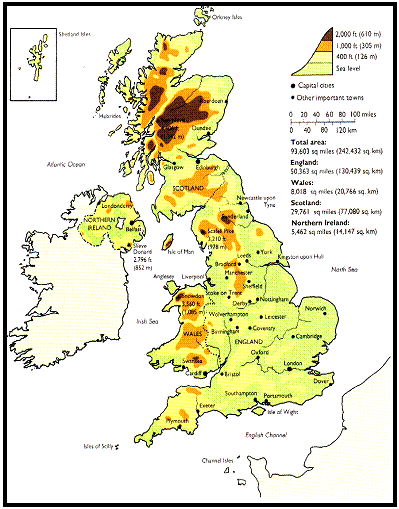
Great Britain lies to the north-west of the continent of Europe. Its official name is the United Kingdom of Great Britain and Northern Ireland. It is situated on two large islands, the larger of which is Great Britain, the smaller is Ireland. In addition to these two islands it includes over 500 small islands.
The total area of Great Britain is 242,432 sq. km. Great Britain consists of four main parts: England, Scotland, Wales and Northern Ireland. Administratively Great Britain is divided into 55 counties.
London is the capital of Great Britain. The biggest cities are Birmingham, Glasgow, Manchester, Liverpool, Edinburgh, Cardiff and others. There are no very long rivers in Great Britain. The most important rivers are: the Thames (the deepest), and the Severn(the longest). The rivers seldom freeze in winter.
English is the official language, although the Welsh language has equal status in Wales. Many other languages are spoken by the ethnic minority communities, which make up around 3 million people. The population of Great Britain is nearly 59 million people.
England is the largest part of Great Britain (it occupies over 50% of the territory and the population amounts to 83% of the total population). The people of England call themselves English. England is an industrial country and was the country in which the development of industry took place.
Wales is a peninsula in the south-west of the island of Great Britain. It occupies about 9% of its territory with the population of 4,8% of the total population. The people of Wales call themselves Welsh. The Welsh speak their own language.
Scotland is the most northern part of Great Britain with the territory of 32% of the total territory and with the population of 9% of the total population. The people of Scotland call themselves Scottish. There are distinct Scottish customs and ways of speaking the English language. Both in Scotland and in Wales there are strong demands for more recognition of their national distinctions through the system of government. Scotland has always had a separate educational system as well as a legal system and local administration.
Northern Ireland has a long history of differences between the Protestant and Catholic sections of the community, based on religion, cultural traditions and national identity. Most Protestants wish Northern Ireland to remain in the United Kingdom, while most Catholics favour unification with the Irish Republic. The British Government is seeking the ways to ensure a political settlement acceptable to all sections of the community.
State organs of the United Kingdom include the monarchy, the legislative, executive and judicial organs of Government.
Britain’s hereditary monarchy is the oldest institution of government, dating back to at least the 9-th century. The present Queen - Elizabeth II - succeeded to the throne in 1952. Although she has a largely ceremonial and politically impartial role as head of state, she serves as a personal symbol of national unity. The Queen is also head of the Commonwealth and presides over the Church of England.
Britain is a parliamentary democracy, with a constitutional monarch. The House of Commons and the House of Lords with the monarch make up Parliament. Parliament is the legislature and the supreme authority. Parliament passes laws, approves taxation and debates the major issues of the day.
The executive consists of the Cabinet of Ministers. The Prime Minister heads the Government and appoints ministers, about 20 of whom are in the policy-making Cabinet.
There are two main political parties in Great Britain: the Labour Party and the Conservative Party.
The administration of justice in Britain is independent of both Parliament and the Government. The judiciary determines common law and interprets statute. Every citizen has the right to equal treatment before the law. Less serious cases are tried by lay magistrates in magistrates’ courts and county courts. People accused of more serious crimes are tried in open court by a judge and jury in Crown Court. The House of Lords is the final court of appeal. A person who needs legal advice or representation in court may get help with the costs out of public funds.
Information for you
Definitions of the courts
Magistrates’ Court - a court held before two or more justices of the peace or a stipendiary magistrate to deal with minor crimes, certain civil actions, and preliminary hearings.
Crown Court - (in England and Wales) local court in which serious criminal cases are tried.
High Court- (also High Court of Justice) - supreme court for civil cases.
The Court of Appeal hears appeals from criminal cases heard in the Crown Courts.
The Court System in England and Wales
1.House of Lords |
2. Court of Appeal |
|
3. Court of Appeal |
4.High Court |
|
5.High Court |
6. County Courts |
|
7. Crown Court |
|

Numbers 1-5 and 7 are superior courts;
numbers 6 and 8 are inferior courts
Word-family
government governmental
уряд урядовий
governor govern governance
правитель‚ правити‚ керування‚
губернатор керувати влада
governess
гувeрнантка
EXERCISES
Ex. 1. Translate the following words and word- combinations into Ukrainian:
hereditary monarchy, impartial role, supreme authority, equal treatment, lay magistrates, political settlement, local administration, national unity, legal advice, common law, government, the House of Lords, court,community, judge.
Ex.2. Match the English and the Ukrainian equivalents:
accused person |
правосуддя |
serious case |
законодавство |
to approve taxation |
обвинувачувана особа |
legislature |
серйозна справа |
executive power |
національні відмінності |
head of government |
затверджувати розмір податку |
national distinctions |
суворі вимоги |
major issues |
Палата громад |
strong demands |
виконавча влада |
broad range of problems |
головні питання |
House of Commons |
широке коло проблем |
justice |
голова уряду |
Ex. 3. Choose the synonyms from the box:
to expand, to favour, recognition, to try, |
to make up, to provide for, magistrate, to charge,
to support, to judge, identifying, to surpass, power.
Ex. 4. Group the following words and word- combinations into 3 logical groups:
Cabinet of Ministers, lay magistrates, approve taxation, policy-making, try, debate issues, judge, pass the law, government, court, House of Lords, legal advice, House of Commons, accuse, appoint, jury, the Prime Minister, Parliament,Crown Court.
Legislature |
|
Executive power |
|
Judiciary |
Ex. 5. Translate the following sentences into Ukrainian:
1. The present Queen Elizabeth II succeeded to the throne in 1952.
2. The British Government is seeking the ways to ensure a political settlement acceptable to all sections of the community.
3. Many other languages are spoken by the ethnic minority communities.
4. The administration of justice in Britain is independent of both Parliament and the Government.
5. Less serious cases are tried by lay magistrates.
Ex. 6. Complete the sentences:
1. English is the official language, although the Welsh language has… 2. The British Government is seeking to ensure … 3. Britain is a parliamentary democracy with a … 4. The executive consists of the … 5. Parliament is the legislature and… |
|
Ex. 7. Insert prepositions:
- Every citizen has the right … equal treatment … the law.
- People accused … more serious crimes are tried … open court by a judge and jury.
- Less serious cases are tried … lay magistrates.
- The Queen serves … a personal symbol … national unity.
- Northern Ireland has a long history … differences … the Protestant and Catholic sections of the community.
Ex. 8. Give English equivalents of the following word combinations:
cуворі вимоги, окрема освітня система, правова система, підтримувати об’єднання, політичне урегулювання, приймати закони, обговорювати головні питання, призначати міністрів, мировий суддя, юридична порада, загальне право, судова влада, законодавча влада, виконавча влада, глава держави, Палата громад, Апеляційний суд, карний суд.
Ex. 9. Translate the words from the box and complete the following sentences:
мирові судді, верховна влада, конституційна монархія, національна єдність, загальні вибори |
1. The present Queen serves as a personal symbol of… .
2. Britain is a parliamentary democracy with a … .
3. The Labour party won the … .
4. Less serious cases are tried by … .
5. Parliament is the legislature and ….
Ex. 10. Form the questions to match the following answers:
- Great Britain is situated on two large islands.
- London is the capital of Great Britain.
- The most important rivers are the Thames and the Severn.
- The present Queen Elizabeth II succeeded to the throne in 1952.
- There are two main political parties in Great Britain.
Ex. 11. Open the brackets and put the verbs into correct forms:
- Administratively Great Britain ( to divide) into 55 counties.
- More serious crimes (to try) in open court by a judge and jury.
- The judiciary (to determine) common law and (to interpret) statute.
- Many other languages (to speak) by the ethnic minority communities.
- Great Britain (to have) a broad range of industries.
- The present Queen (to succeed) to the throne in 1952.
Ex. 12. Find the answers in the text:
- What are the main parts of Great Britain?
- How many islands is Great Britain situated on ?
- What is the largest one?
- Who is the head of the state?
- What is the official name of Great Britain?
- What are the main political parties in Great Britain?
- What is the Queen’s role in government?
- What does the executive consist of?
- What does the legislature consist of?
- What does the judiciary consist of?
Ex. 13. TranslateintoEnglish:
Британія - парламентська монархія. Палата лордів, Палата громад та монарх складають парламент. Парламент – це орган законодавчої та верховної влади. Парламент приймає закони, затверджує розмір податку та обговорює головні питання дня. Кабінет Міністрів є вищим органом виконавчої влади. Прем’єр – міністр очолює уряд та призначає міністрів, приблизно 20 осіб, які являють собою сформований кабінет.
Ex. 14. Speak about Great Britain using the following information:
Territory – 242,432 sq. km
Population – 59mln people
Status – parliamentary monarchy
State language – English
Head of State – Queen
Legislature – Parliament
Executive – Cabinet of Ministers; Prime Minister
Judiciary – House of Lords, High Court,Crown Court, Court of Appeal
Capital – London
Сurrency – pound sterling
- lies to
- is situated
- consists of
- is divided
- is highly industrialized
- excels in high-technology industries
- succeeded to the throne
- presides over the Church of England
- passes laws, approves taxation, debates the major issues
- appoints ministers
- has the right to equal treatment
- are tried in open court by a judge and jury
- are tried by lay magistrates
Grammar Exercises
Reported speech |
Ex. 1.Convert direct speech into reported speech:
- “We study the history of Great Britain.”
The cadet said_____________________________________
- “My name is Kate.”
The girl said______________________________________ - “I’ll visit London next year.”
He told us ________________________________________ - “I looked for witnesses of the accident.”
The officer said ___________________________________ - “What is the most northern part of Great Britain?”
The teacher asked the cadet___________________________ - “Do you like to travel?”
He asked me_______________________________________ - “What do state organs of the United Kingdom include?”
The professor asked the cadet ________________________ - “I am a cadet of the National Academy of Internal Affairs of Ukraine.”
The young man said ________________________________ - “What are you doing? Are you translating the text about Great Britain?”
The teacher asked the cadet __________________________