Topic: Asking the way |
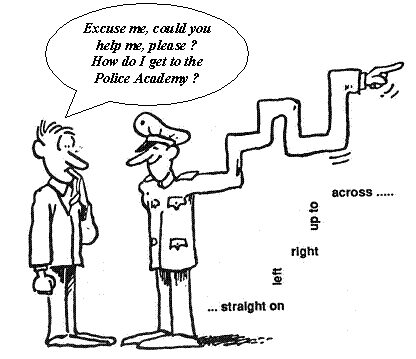
Remember the following conversational formulas
Attracting attention |
Як привернути увагу |
Excuse me. |
Вибачте, прошу. |
Pardon me. |
|
Sorry. |
|
Can I help you? |
Чи можу я Вам допомогти ? |
Asking the way |
Як спитати дорогу |
Can/could you direct me to …? |
Чи можетe ви сказати мені |
Can/could you tell me the way |
як пройти до …? |
How do/can I get to …? |
Як мені пройти до ...? |
Does this street go/lead to …? |
Чи ця вулиця приведе мене |
I am looking for … |
Я шукаю… |
Is it a long way to …? |
Чи далеко до …? |
Am I on the right way to …? |
Я на правильному шляху |
Is this the right way to…? |
Чи це вірна дорога до …? |
Where is the nearest…? |
Де найближчий …? |
Which is the shortest way to…? |
Який шлях найкоротший |
Thanks and Replies to Thanks |
Як подякувати та відповісти на подяку |
Thanks. |
Дякую. |
Thanks a lot. |
|
Thank you very much. |
|
Don’t mention it. |
|
Not at all. |
|
That’s all right. |
|
You are welcome. |
|
It’s all part of the job / in the line of duty. |
Це входить в мої обов’язки. |
Directions |
Як пояснити дорогу |
Go / walk along Khreschatyk street. |
Ідіть по вулиці Хрещатик. |
Go straight ahead. |
Ідіть прямо. |
Go down/up. |
Ідіть вниз / вгору. |
Go to the end of the street. |
Ідіть до кінця вулиці. |
Take the first / second turning on the right. |
1-ий / 2-ий поворот праворуч. |
Turn left at the crossing/ crossroads. |
Поверніть ліворуч на перехресті. |
round the corner. |
за рогом. |
at the traffic lights. |
біля світлофору. |
Cross the street / bridge. |
Перейдіть/проїдьте через вулицю/міст. |
Use the pedestrian / zebra crossing [GB], crosswalk [US] |
Скористайтесь переходом. |
Take the first / second road on your right / left |
Перша/друга вулиця (дорога) праворуч/ліворуч. |
Walk two blocks. |
Пройдіть два квартали. |
Take number 602 tram/bus |
Сідайте на трамвай/автобус номер 602 до … |
The nearest bus / tram stop |
Найближча зупинка автобуса / трамвая ... |
Go 2 stops. |
Проїдьте дві зупинки. |
Get off at the next stop |
Виходьте на наступній зупинці |
at the last stop |
на останній зупинці |
at the last but one |
на передостанній зупинці |
Change for/to number 5 bus. |
Пересядьте на автобус номер 5. |
Transfer for/to number 5 bus. |
|
(Keep) straight on two blocks and then turn to the right. |
Два квартали прямо і потім праворуч. |
Is it long way from here? |
Це звідси далеко? |
It's no distance at all. |
Зовсім близько. |
It’s not far, actually. |
Це дійсно недалеко. |
It’s quite far, really. |
Це дійсно далеко. |
Is it far? |
Це далеко звідси? |
Only about ten minutes' walk |
Хвилин десять пішки. |
You can walk it under 10 minutes. |
Менше десяти хвилин пішки. |
Should I take a bus? |
Мені слід сісти на автобус? |
What bus should I take? |
На який автобус мені сісти? |
Does this bus/ trolley-bus/ tram go to …? |
Чи цей автобус, тролейбус, трамвай їде до…? |
Will this bus take me to…? |
Чи доїду я цим автобусом до…? |
How many stops are there from here to … ? |
Скільки зупинок звідси до…? |
Have I got to change? |
Чи потрібно мені пересідати? |
Please, tell me where to get off (to change for a bus)? |
Скажіть, будь ласка, на якій зупинці мені вийти (пересісти на автобус)? |
How much is the fare? |
Скільки коштує проїзд? |
It’s on the right/left. |
Це праворуч / ліворуч |
Keep to the right/left. |
Тримайтесь праворуч / ліворуч |
Carry (straight) on. |
Тримайтесь прямо. |
Follow the road. |
Слідуйте по дорозі. |
Turn right/left at the next set of traffic lights. |
Поверніть ліворуч / праворуч на наступному світлофорі. |
Cross the street. |
Перейдіть вулицю. |
Use crossing. |
Йдіть через пішохідний перехід. |
You'd better take number 9 bus. |
Вам краще сісти на автобус номер 9. |
You'd better take a taxi |
Вам краще взяти таксі. |
| Заборони | |
You’re not allowed to turn left / right, I’m afraid |
Вам не можна повертати |
You’re not allowed to park / leave your car here. It’s a no-waiting area! |
Тут Вам не можна припарковуватись/ залишати Ваш автомобіль.Це не місце для зупинки! |
You’re not allowed to drive along here. It’s one-way street. |
Тут проїзд не дозволяється. Тут односторонній рух. |
| Нагадування | |
Remember to turn left at the traffic lights. |
Пам’ятайте, що потрібно повернути ліворуч біля світлофору. |
Don’t forget to follow the blue motorway signs. |
Не забудьте слідувати згідно з голубими дорожніми знаками. |
Ex. 1. Read and translate the dialogues:
“Information about routes”
Dialogue 1
Passenger (Р): Where is the nearest bus-stop, please? Can I walk there?
Militiaman (М):Certainly. It's not very far from here. You should cross the square. Use zebra crossing .
P:I am looking for the Ministry of Internal Affairs of Ukraine. What bus should I take?
M:You may take any bus from here.
P:Where should I get off?
M:This bus goes to Khreschatуk street. The Ministry is not far from it.
P: Thank you very much.
М: Not at all.
Dialogue 2
The driver of a British registered car addresses the police officer.
Driver (D): Excuse me, how do I get to Zhytomyr then? Can you tell me the way?
Police officer (P): Of course, do you have a road map? Then it’s easier to explain.
The man goes back to his car, opens the boot, takes out a road map and spreads it out on the bonnet of his car.
P: We are right here now.
D:Yes, I see.
P: First you have to go through the next village and then on to Makariv until you get to big busy crossroads. When you approach the crossroads, watch the road signs.You haven’t got the right of way. Then follow the blue signs for Zhytomyr.
D: If the route to the motorway is well signposted, it’ll be easy to find.
P: Have a nice trip.
Dialogue 3
Passer-by (Р): Excuse me. Could you help me?
The Militiaman (M): Sure. What’s the problem?
P.: Could you tell me the way to the National Academy of Internal Affairs of Ukraine. Can I walk there? Is it too far?
M.: It’s about twenty minutes’ walk. But you may take a tram or a bus. The bus and the tram stops are at the same place.
P.:Where is it?
M.: Go straight ahead to the crossroads. Then turn right and go along the street to the next crossing. And you’ll see the bus stop.
P.: Thanks a lot.
M.:You are welcome.
Dialogue4
A traffic check
Officer: Добрий день! Мене звуть Петро Сидоренко. Я проводжу дорожній контроль.
Driver: Sorry, what's that?
Officer: Oh, good morning. This is a routine traffic check, sir.
Please switch off the engine and the radio. Could I see your documents please? Driving licence and green insurance card ...
Тhank you, Mr Brown ...
Do you live in Ukraine or are you just travelling?
Driver: I'm just travelling. I'm on my way to Lviv as a matter of fact.
Officer: I see. Right, could you just switch on your headlights... first dipped... and then full beam ... OK ... now your indicators ... first right... and then left ... all right ... now your rear lights ... your rear fog light and then your reversing light... and step on the brake. Thank you.
Driver:Is everything all right?
Officer: I'm afraid your right-hand rear light isn't working.
Driver:May I drive on?
Officer:Yes, but get it fixed at the garage down the road. Here are your documents. Have a nice trip.
Driver:Thank you, officer.
Dialogue5
A man is seen approaching hisforeign-registered car. The way he walks аnd the fact that he is apparently finding it difficult to open the door suggest nat he has been drinking.
Police officer (P.O.):Good evening, sir. Constable Jones.
Motorist (M):Sorry, what's that? What's the matter?
P.O.: Well, I had the impression that you weren't walking normally and I can smell alcohol now that I am standing next to you.
M.:But I've only had two beers. That's all I've had.
P.O.: Well, you know that it is very dangerous to drink and drive even with a small quantity of alcohol.
M.:But it was only a couple of beers with my meal.
P.O.: If you think you have really drunk so little... However, we can make sure with a breathalyzer test.
M.: Do I really have to take the test?
Р.О.: No, it is voluntary. But it will definitely show your blood alcohol concentration.
M.: Oh? How does that work?
Р.O.: It's all very simple, really. This is our breathalyzer device. Now, it is very important that you haven't smoked within the last five minutes and that you haven't drunk any alcohol within the last fifteen minutes.No problem there. Let's try it out.
Р.О.:This is the device and this is the mouthpiece, which is sterile. This is where you've got to blow. Now blow hard and keep blowing until the acoustic signal stops.
М.: What does it show? Р.О.: Have a look at it yourself. The device shows 1.5 %.
М.: What does that mean? Is that over the limit? Am I not allowed to drive a car now?
Р.О.: It's definitely over the limit. You can't possibly drive with so much alcohol in your blood. In other words, you are not allowed to drive.
М.: Well, if that's the case, I'd better leave the car here. But I've got to get to my hotel. It's too far to walk.
Р.О.: We can get you a taxi if you wish.
М.: That's a good idea. Thank you very much officer.
Ex. 2. Make up dialogues using the situations:
Situation 1: A stranger comes up to you in Kyiv and asks to show the way to the theatre, (the museum, the stadium ). Give him or her the necessary directions.
Situation 2: You come out of a hotel where you are staying. You want to get to the police station (the Flower street, the supermarket, the cinema, the library). But on crossing the road and taking the first turning on your right you feel you are losing the way. You address a passer-by.
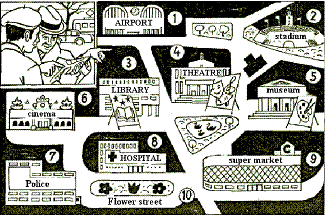
Situation 3: Discribe the route from the Police Academy to your home.
OUR INFORMATION
Roads and highways
Ukraine |
United Kingdom |
United States |
aвтострада |
Motorway - M 25 |
Interstate – I 20 |
дорога, яка підпорядкована державі |
A road – A 68 |
U.S. road – U.S. 1 |
дорога, яка підпорядкована області |
B road – B 632 |
state road – Texas 12 |
дорога в сільській місцевості |
C road – C 37 |
county road – Klamath 17 |
|
D road – D 76 |
farm road / country road |
Ex. 3. Translate into English and compose the dialogues of your own:
- Запитайте водія, чи він має при собі карту місцевості.
- Скажіть йому, що він спочатку повинен їхати прямо і лише за другим світлофором повернути ліворуч.
- Скажіть водієві, що йому потрібно через сто метрів переїхати через міст.
- Запропонуйте йому залишити автомобіль на стоянці, а решту шляху до центра міста пройти пішки або сісти на трамвай (автобус, тролейбус, таксі).
- Поясніть йому, що він знаходиться на вулиці з одностороннім рухом і не має права зробити розворот.
Ex.4. Read and translate the text using the vocabulary notes:
Vocabulary notes:
lane n |
[lein] |
провулок |
pave v |
[’peiv] |
мостити, брукувати |
vehicle |
[’vi:іkl] |
транспортний засіб |
motor-cycle n |
[moutə s’aikl] |
мотоцикл |
motor-scooter n |
[‘moutə ‘sku:tə] |
моторолер |
traffic n |
[’træfik] |
рух, транспорт |
suburbs n |
[‘sʌbə:bz] |
передмістя, околиці |
rush hour |
[rʌʃ auə] |
година пік |
policeman on point duty |
[pɔint] [‘dju:ti] |
регулювальник |
pedestrian n |
[pi’destriən] |
пішохід |
traffic-lights n |
[’træfik laits] |
світлофор |
crossroads n intersection |
[‘crɔsrɔudz] |
перехрестя |
underground (subway) |
[ʌndə’graund] [‘sʌbwei] |
підземний перехід |

A TOWN
A town is a large number of houses, schools, hospitals, theatres, factories,shops and other buildings built near each other. All these buildings are divided into blocks by streets. Short narrow streets that join larger ones together are called lanes. On one side of the streets the buildings have even numbers, on the other – odd numbers. The streets are usually paved with asphalt.
In the streets, roads and squares of the town we see people walking and vehicles driving. The vehicles are trams, buses, trolley-buses, motor-cycles, taxis, minibuses, motor-scooters, cars, bicycles. We can’t imagine life without traffic. They connect the centre with the suburbs. During the morning rush hour the transport system is usually overcrowded. During the evening rush hour, with everyone hurrying home it carries the greatest amount of passengers too.
On both sides of the street there are pavements where people walk. People usually cross the streets at special places called crossings. When the traffic is heavy the policeman on point duty has to stop the never-ending stream by raising one hand, thus affording the pedestrians a chance to cross the street. At the corners of the streets there are traffic lights.
When the red light is switched on the traffic stops, when the green light is switched on the vehicles drive on. In any case, before crossing the road take care to look to the left and when you reach the middle of the road, look to the right. At big crossroads in large towns and cities there are underground crossings for pedestrians.
In England vehicles drive on the left. In Ukraine the traffic drives on the right. In very large towns which are called cities the fastest and the most convenient means of transport is the Metro. You can get from one end of a city to another in no time. In the Metro you find signs showing you where to change for other lines. In the centre and the important parts of a large town, there are squares, parks and market places.
A town is generally situated near or on a river across which bridges are built. In all towns there are places of interest, which a stranger would be invited to see - monuments, cathedrals, museums, and so on .
A town is governed by a council, the head of which is styled the mayor. The police maintain public order, control the traffic and protect the people from different criminal individuals.
Ex. 5. Answer the questions:
- What do we call short narrow streets that join larger ones together?
- What are vehicles ?
- What do we call hours when the city transport system carries the greatest amount of passengers?
- Where should one cross the street?
- What are the things the pedestrians must remember to be safe and sound?
- On which side do vehicles drive in England?
- What do we call the underground railways in Kyiv, London, New York?
- What means of transport do you prefer?
- Have you ever used the underground in London or other cities abroad?
Ex.6. Match the nouns in columns A and B to make compound nouns:
A B
traffic stop
bus light
bicycle station
subway entrance
stop sign
parking lane
street stand
news jam
taxi space
shop cafe
neon window
Grammar Exercises
1. Modal Verbs and their equivalents |
Ex. 1. Translate into Ukrainian. Underline modal verbs and their equivalents:
1. How can I get to the center of the city? 2. An investigator must be very attentive. 3. There will be no meeting after classes. You may go home. 4. The cadets should work at their English every day. 5. May I take this textbook on Criminology? – I am afraid, not. 6. A prosecutor must supervise the correct application of law. 7. You will have to come here again.
Ex. 2. Make the following sentences interrogative and negative. Translate them:
He can read and write English and French. |
- She can buy a ticket at the railway station.
- You should get off at the next stop.
- He can drive a car.
- You have to take the underground to get to the centre of the city.
- I could see the driver clearly as the street was brightly lit.
Ex. 3. Put personal pronouns in brackets into objective case. Translate thesentences:
- Do you know (she)?
- Tell me everything about (they).
- The gun belongs to (I).
- I’ll call for (you) at 8 o’clock, and we’ll go to the police station.
- I’ll speak with (he) about you.
- We suggest that he informs (we) about his work.
Ex. 4. Make the following sentences interrogative:
He sees nobody in the room. |
- You can meet somebody in the street at this time.
- He knows something about this accident.
- They have to ask somebody to help you to do this work.
- I am sure you can get this textbook somewhere.
- Someone has called the police station.
- Somebody must report to the chief about this case.
- The suspect was hiding something in his pocket.
Ex. 5. Translate into English:
- Як я можу дістатися до центру міста?
- Можна мені тут палити?
- Нам слід допомогти йому.
- Я повинен буду зробити доповідь.
- Курсанти aкадемії повинні носити форму.
- Сідайте на цей автобус, і ви зможете доїхати до Солом’янської площі.